The Advanced TDEE Calculator
Welcome to TDEE Calculator Online, If you are reading this, you are likely looking for more than just a random number generator. You are looking for a roadmap for your fitness journey. Whether your goal is losing weight, building lean muscle, or simply understanding your body better, we built this tool to be the last resource you will ever need.
When we designed this platform, we realized that most calculators stop at the basics. They give you a number and wish you luck. We take a different approach. We believe that sustainable weight loss and effective muscle gain require a complete picture of your physiology (read more about our mission and methodology). That is why our tool doesn't just calculate your Total Daily Energy Expenditure (TDEE); it acts as a comprehensive nutrition plan generator, offering insights into your BMI, ideal weight, and macronutrient ratios.
What Is TDEE and Why Does It Matter?
At its core, your TDEE represents the total number of calories your body burns in a 24-hour period. It is the mathematical anchor for any health goal. Think of it as your body's budgetary baseline.
To understand how to calculate TDEE, we have to look at the four distinct components that make up your daily energy burn. When you input your data into our calculator, we are analyzing:
- Basal Metabolic Rate (BMR): This is the energy required for basic bodily functions like breathing, cell production, and regulating body temperature. Even if you stayed in bed all day, you would still burn these calories.
- Thermic Effect of Food (TEF): Believe it or not, eating burns calories. Digestion and processing nutrients require energy. A high-protein diet often increases this effect.
- Non-Exercise Activity Thermogenesis (NEAT): This covers all your daily movement that isn't deliberate exercise, walking to the car, fidgeting, or typing at a desk job.
- Exercise Activity Thermogenesis (EAT): The energy burned during resistance training, cardio, or any dedicated physical activity level.
By summing these up, we determine your maintenance calories, the exact energy intake required to keep your current weight stable.
The Science Behind Our Accuracy
Accuracy is the most critical factor in a TDEE calculator. A healthcare professional or dietitian doesn't guess; they use proven formulas. We do the same.
Our tool utilizes the Mifflin-St Jeor equation, widely considered the gold standard for accuracy in clinical settings. For active individuals and athletes, we also incorporate elements of the Harris-Benedict equation and the Katch-McArdle equation (which accounts for lean body mass if you know your body fat percentage).
We don't just ask for your age, weight, and height. We dive deeper. By adjusting for your specific activity multiplier, ranging from a sedentary lifestyle to extra active physical jobs, we ensure your TDEE calculated result is tailored to your real life.
Why You Need to Know Your TDEE
Understanding your TDEE is the difference between guessing and knowing.
- To Lose Weight: You must consume fewer calories than your TDEE to create a caloric deficit.
- To Gain Muscle: You need a slight calorie surplus to fuel muscle growth and recovery.
- To Maintain: You simply match your daily calorie intake to your expenditure.
Many people fail because they underestimate their daily calorie needs or overestimate how much they burn during hard exercise. Our tool removes that ambiguity, giving you accurate results you can trust.
Decoding Your Results: A Complete Health Blueprint
Customizing Your Weight Management Goals
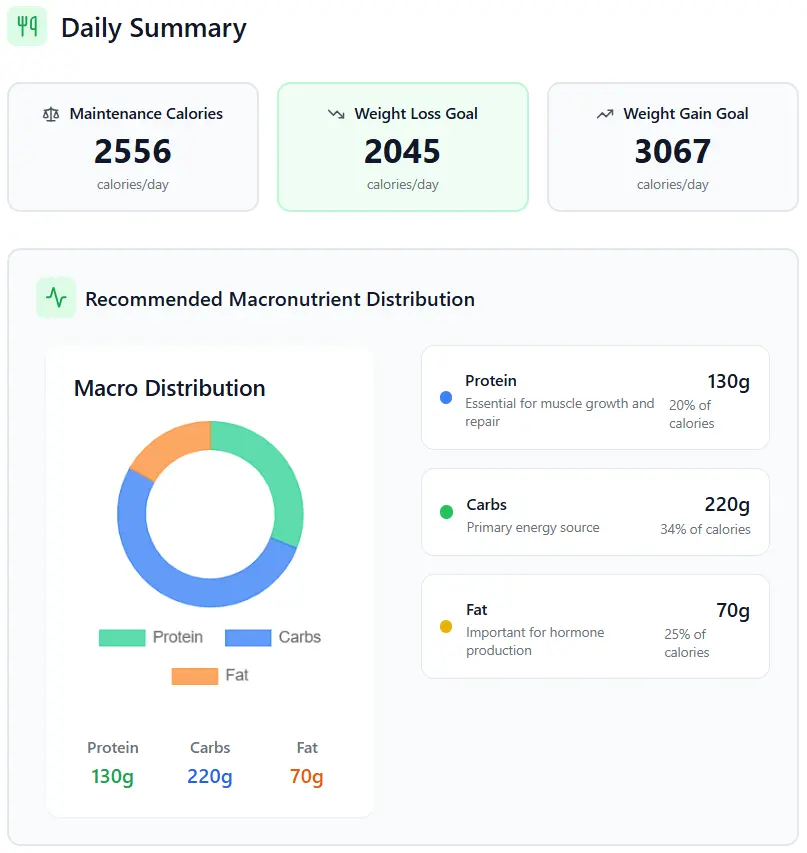
Once you hit "Calculate," we don't just hand you a single number. We provide a spectrum of options because we know that weight loss goals are personal.
Our Weight Loss Calculator logic breaks down your targets into actionable tiers:
- Maintenance: This is your TDEE. Eating this amount supports weight maintenance and keeps your current physique stable.
- Moderate Weight Loss: By creating a sustainable 500-calorie deficit, you can aim to lose about 1 lb per week without sacrificing lean body mass.
- Aggressive Weight Loss: For those with a shorter timeline, this option increases the caloric deficit. However, we always recommend consulting a healthcare provider before cutting calories drastically, as it can impact energy levels and cell production.
- Muscle Gain (Bulking): To gain muscle, you need energy. Our calorie surplus recommendations are designed to fuel muscle growth (hypertrophy) while minimizing fat gain.
The Power of Macronutrient Ratios
Calories are the fuel, but macronutrients are the building blocks. A calorie is not just a calorie when it comes to body composition. This is why our tool doubles as a precision Macro Calculator.
We offer three distinct Macronutrient Ratios to match your training style:
- Moderate Carb (30/35/35): A balanced approach ideal for most people starting a health journey. It provides enough energy for daily activities and light exercise.
- Lower Carb (40/40/20): Often preferred for losing weight quickly. This high-protein approach helps preserve muscle tissue while your body burns stored fat.
- Higher Carb (30/20/50): Designed for athletes performing hard exercise or endurance training. The extra calories from carbohydrates replenish glycogen stores depleted during intense physical activity.
Whether you are focused on strength training or just general health, getting your protein intake right is non-negotiable. Our Protein Calculator logic ensures you get enough amino acids to repair tissue after resistance training.
Beyond BMI: Understanding Your Ideal Weight
We include a BMI Calculator because Body Mass Index is a useful screening tool used by doctors worldwide. However, we know it has limitations, it doesn't account for muscle mass. A bodybuilder might check their BMI and see "Overweight" simply because muscle is dense.
To give you a fairer picture, we calculate your ideal weight using four distinct medical formulas:
- Hamwi Formula: often used for estimating frame size.
- Devine Formula: widely used in medical dosing.
- Robinson Formula and Miller Formula: variations that account for different body compositions.
Seeing these ranges helps you set a realistic weight goal that makes sense for your specific frame, rather than chasing an arbitrary number.
Elevate Your Results with Our Nutrition Dashboard
Knowing your numbers is step one. executing them is step two. This is where our advanced Nutrition Dashboard comes in.
We have integrated a nutrition plan generator directly into the platform. Instead of just tracking numbers in a Calorie Counter, our dashboard acts as your personal dietitian. It helps you translate abstract "calories" into actual food choices.
By analyzing your energy requirements and dietary preferences (whether you eat everything, are vegetarian, or vegan), the dashboard can suggest meal plans that hit your exact daily calorie needs. This bridges the gap between the math of weight loss and the reality of grocery shopping and cooking.
Tailored Calculations for Every Lifestyle
A one-size-fits-all approach doesn't work for human biology. A construction worker and a software developer might have the same height and weight, but their energy requirements are vastly different. Our tool adapts to your specific physical activity level to ensure you get accurate results.
The Impact of Activity Levels
One of the most common mistakes people make is misjudging their activity. We use a precise activity multiplier to adjust your TDEE based on your honest input:
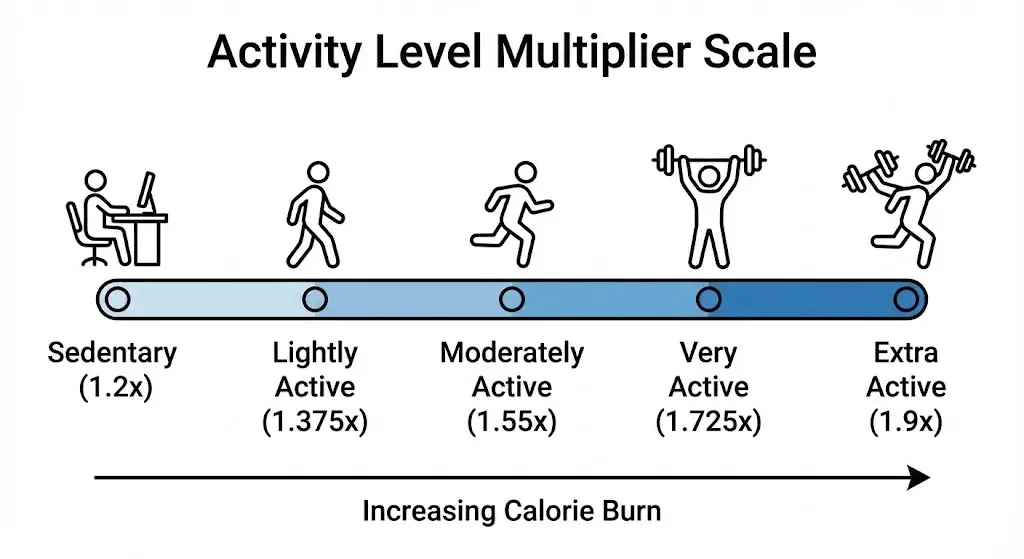
- Sedentary Lifestyle: If you have a desk job and get little to no intentional exercise, your daily movement is limited. We calculate this conservatively to prevent overeating.
- Light to Moderate Exercise: For those who train 1-5 days a week. This accounts for the calories burned during resistance training or cardio sessions.
- Extra Active: If you work a physical job (like landscaping or construction) or are a competitive athlete training twice a day, your body demands significantly more fuel.
By selecting the correct tier, we calculate the Non-exercise activity thermogenesis (NEAT) and Exercise activity thermogenesis accurately, ensuring your nutrition plan supports your day-to-day life.
Gender-Specific Calculations
Men and women biologically burn energy differently. Men typically possess more lean body mass naturally, while women often have higher essential body fat levels for hormonal health.
- For Men: The algorithms prioritize higher muscle mass baselines, often resulting in slightly higher maintenance calories.
- For Women: The equations adjust for female metabolic rates. We are also working on features to account for pregnancy and breastfeeding, which drastically alter daily calorie needs.
The Science: Formulas We Use
Transparency is key to trust. We don't hide our math. We utilize the most respected equations validated by organizations like the American Council on Exercise and the Academy of Nutrition and Dietetics.
1. The Mifflin-St Jeor Equation
This is currently considered the most reliable equation for the general population. Published in 1990, it effectively estimates RMR (Resting Metabolic Rate) for modern lifestyles.
Why we use it: It provides the most sustainable weight loss baseline for 90% of users.
2. The Harris-Benedict Equation (Revised)
Originally created in 1919 and revised in 1984, this formula is excellent for active individuals. It tends to estimate a slightly higher BMR, making it suitable if you have a high physical activity level.
3. The Katch-McArdle Equation
This is the "Athlete's Choice." Unlike the others, this formula requires your body fat percentage.
Why it matters: If you are lean with high muscle mass, other formulas might underestimate your needs. By inputting your body fat, Katch-McArdle ignores total weight and calculates based strictly on lean body mass, giving you the most precise number for muscle gain or cutting.
Why Accuracy Matters for Long-Term Success
Guessing your calories is like driving with a blindfold. If you underestimate your maintenance level, you might crash diet, leading to fatigue and muscle loss. If you overestimate, you might wonder why you aren't losing weight despite your efforts.
Our goal is long-term health, not quick fixes. By providing a scientifically grounded calorie target, we empower you to make food choices that fuel your body correctly. Whether you are creating a caloric deficit to shed fat or a surplus to gain muscle, the math has to be right first.
Save, Share, and Succeed: Tools for Accountability
We know that a fitness journey isn't a one-day event; it is a process. That is why we built features to help you track your progress over time.
Download Your Blueprint
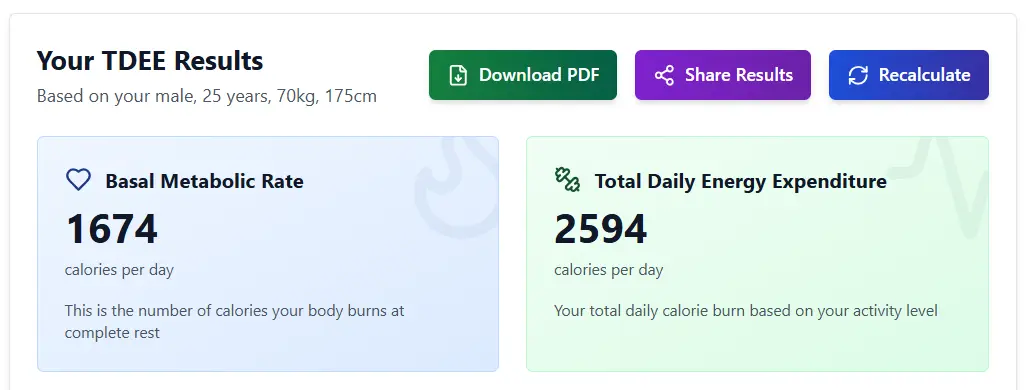
Once you have your results, you don't need to scribble them on a napkin. Use our Download PDF feature to generate a professional report of your stats. This includes your Macronutrient Ratios, your BMR, and your weekly calorie targets.
Pro Tip: Print this out and stick it on your fridge, or save it to your phone for quick reference when grocery shopping or dining out.
Share for Accountability
Research shows that people who share their fitness goals are more likely to achieve them. Our new Share Result feature makes it easy to send your nutrition plan to a friend, personal trainer, or healthcare provider. Whether you are working with an online coach or just have a gym buddy, keeping everyone on the same page regarding your energy intake has never been easier.
Frequently Asked Questions (FAQ)
What is the difference between BMR and TDEE?
Your BMR (Basal Metabolic Rate) is the energy your body burns just to stay alive, imagine you are in a coma. Your TDEE (Total Daily Energy Expenditure) adds your daily activities, daily movement, and exercise on top of that. For weight management, you must always use your TDEE, not your BMR, or you will severely under-eat.
How often should I use the TDEE Calculator?
You should recalculate every time your weight changes by 5-10 pounds. As you are losing weight, your body becomes smaller and requires fewer calories to maintain itself. This metabolic adaptation is normal. Updating your numbers ensures your calorie deficit remains accurate throughout your weight loss journey.
Is this safe for people with health conditions?
While our tool provides scientifically accurate estimates based on the Mifflin-St Jeor Formula, it is an algorithm, not a doctor. If you have specific health conditions (like thyroid issues or diabetes) or are pregnant, please consult a healthcare professional. They can provide a medical diet plan tailored to your specific physiology.
Do I need to do calorie counting forever?
Not necessarily. Calorie counting is a tool to teach you about portion sizes and food choices. Many users track strictly for a few months to learn what their maintenance calories look like, then switch to intuitive eating once they understand their body's needs.
Can I use this for the Carnivore or Keto diet?
Absolutely. Our Macro Calculator allows you to adjust your ratios. If you are on a low-carb or Keto diet, simply select the "Lower Carb" or "Higher Fat" options in your results to see how to structure your lean proteins and fats while staying within your calorie target.
Have a question we didn't answer here? Visit our dedicated Help & FAQ page for a complete guide on metabolic science and troubleshooting.
Start Your Transformation Today
Your health goals are within reach, but they require a plan. By using TDEE Calculator Online, you are taking the first step away from guessing and toward scientific, sustainable weight loss and health.
Whether you are here to gain muscle, shred fat, or simply feel better in your daily life, the numbers don't lie. Enter your stats, get your accurate results, and let's build the best version of you.
Last Updated: December 25, 2025